
 By developer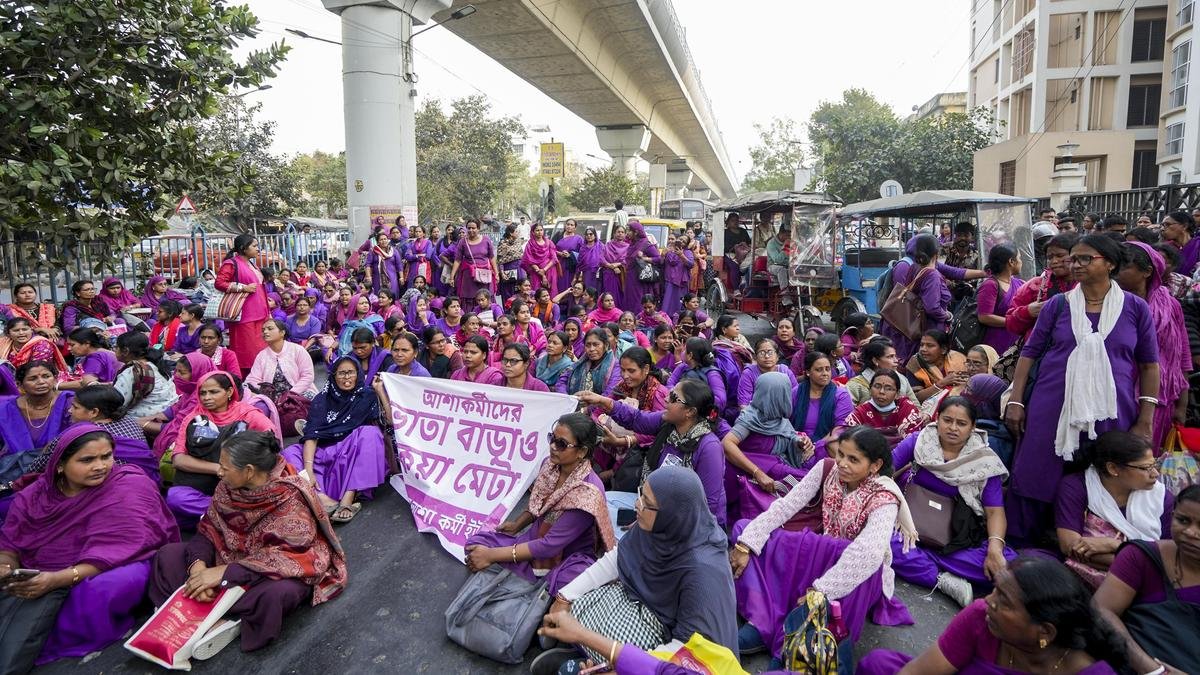
Intro :
For ASHA workers, even survival is a struggle. The COVID pandemic revealed the worst realities of India’s ramshackle healthcare infrastructure. A key element in India’s healthcare system is the half a million strong ASHA workers, who are the first responders for India’s rural and urban poor. Poor pay and lack of any safety gear was only made worse by irregular pay.
ASHA workers were subjected to violence, harassment and became especially vulnerable to the spread of the pandemic, owing to lack of safety gear and protection. Despite the difficulties, ASHA workers worked bravely through the pandemic to ensure every Indian down to the poorest were vaccinated. The success of India’s mass vaccination owes much to the sacrifices of the ASHA workers.
State governments have the responsibility of ensuring the pay of ASHA workers. Many state governments failed to pay these first responders. It is why most of the ASHA workers strikes since the nationwide mobilization in 2021, were directed against the state governments.
There are over 70,000 ASHA workers in West Bengal, who have been at the forefront of the fight against COVID, but remained unpaid. This is the context behind the cease work protest undertaken by the ASHA workers of West Bengal. On the 21st of January, this protest reached a culmination, when thousands of ASHA workers descended on Calcutta, all for a simple demand for entering into negotiations with the Health department. The city authorities reacted with arrests, blockades and violent harassment.
ASHA workers cease work:
For the last 40 days, the ASHA workers of West Bengal have been on cease work protest, where they refrain from all duties except emergency duties. On the 7th January a massive ASHA (Accredited Social Health Activist) workers protest took place before the headquarters of the Health Department of the Government of West Bengal. ASHA workers have been the first responders for many of India’s poor, and were on the frontlines of India’s vaccination drive. This all woman workforce has been the unsung pillar of India’s healthcare system, yet they remain underpaid, overworked, abused and most vulnerable to health risks.
Soon after the COVID pandemic, ASHA workers went on the path of struggle to secure their rights as healthcare workers. The first big mobilization came with the ASHA workers strike in September 2021 which saw 600,000 ASHA workers on strike. Since then, there have been significant regional strikes involving ASHA workers, such as the indefinite strike by Delhi State Anganwadi Workers Union (DSAWHU) in 2021 and 2022.
There have been victories by ASHA workers in Bihar and Karnataka over the last two years. The momentum continues, now with the protests of ASHA workers in West Bengal. It is significant because West Bengal was among the most affected states of India during the COVID pandemic, but also because of the support from the West Bengal Junior Doctors Forum, one of the leading organizations of the Doctor’s strike in 2024.
Despite protests before the Health Department headquarters, the ‘Swasthya Bhavan’, the West Bengal government remained adamant in conceding to any of the ASHA workers’ demands. The claim of the TMC government, is that the ASHA workers have no case to make these demands or enter into this strike, because “they are paid the highest compensation in the country”. The compensation for ASHA workers in West Bengal is barely above Rs. 5000 a month, it would compute to less than a dollar a day.
The silence and stubbornness of the government increasingly became intolerable. On the 21st of January, the state government called for a meeting with the striking ASHA workers. It was decided that the ASHA workers would march from various districts of the state and converge on the Swasthya bhavan to press their nine demands, foremost among them is the demand for 15000 rupee honorarium instead of the pittance they’re paid currently, and recognition as healthcare workers than ‘activists’.
More than 70,000 ASHA workers entered Calcutta from various district centers, entering through railway stations. Rather than even try and listening to their demands and negotiate, the state government’s response was to send the police to barricade the roads, and arrest the ASHA worker’s leaders.
The crackdown spread across the state, with the police forces arresting and harassing ASHA workers. There was little concern for the fact that these were healthcare workers whose job saved lives, or that they were mostly women. The ASHA workers in protest were understandably irked by this action, rather than accept the repression of the police, the ASHA workers fought back.
Twenty thousand ASHA workers arrived to the city to protest, thousands of workers gathered in protest sites in various critical points of the city. The ASHA workers broke through barricades at Salt Lake in Eastern Calcutta, and at Dharmatalla in the Central part of the city. The police used unprecedented force on women workers, all of which became recorded live on TV for the whole city to watch. Once the ASHA workers fought back, the police retreated.
The ASHA workers were indomitable, they began occupations and continued to protest with the singular demand that the state government must negotiate with them in good. The most strategic occupation took place near Dharmatallah, on S.N Bannerjee street which is the main arterial road connecting Central Calcutta with the crucial Sealdah station, Calcutta’s second biggest railway hub. The protesters made militant speeches, and found support among passers by offering tea and refreshments.
The police maintained barricades and a presence surrounding the protesters, but did not dare attempt to break the protests. By the end of the day, the government was forced to allow the delegation of ASHA workers to negotiate. At that point, the occupations were slowly withdrawn. However, even here the state did not stop resorting to their dirty tricks, not a single representative of the government came to the meeting.
WBJDF expresses solidarity:
Over the course of the day, several organizations, including the Communist Party of India (Marxist) linked, DYFI (Democratic Youth Federation of India) who were also conducting a protest near the occupation site facing the Municipal Headquarters, expressed their support for the ASHA workers. The AIUTUC (All India United Trade Union Centre) linked with the SUCI also came out in support. However, what could potentially be the most significant development, is the support of the West Bengal Junior Doctor’s Federation.
During the massive doctor’s protest, practicing resident junior doctors were at the forefront, they received solidarity from every section of permanent healthcare workers, but the issues of ASHA workers were not brought to the fore. However, if the junior doctor’s movement aligned with the ASHA workers, it would widen the base of solidarity enormously, and bring together both organized healthcare workers who are mostly focused in hospitals, and informal healthcare workers who conduct door to door work.
The doctor’s movement last year represented the most significant challenge to the power of the TMC government in West Bengal, it also represented a very politically conscious and organized mobilization which resonated across the country. Even though the doctors had only won a pyrrhic victory, it shook the authority of the TMC to its core, and brought the issues facing healthcare work in India to the fore, among which safety for female doctors are chief issues.
Most ASHA workers had been supportive towards the TMC, having landed these jobs with the help of the party. Today, that pact seems broken, and those who had once supported the TMC have turned decisively against it.
Capitalist healthcare and exploitation:
The exploitation of the ASHA workers and the junior doctors are part of the same broken healthcare system, one that prioritizes profit motive over public service. India has one of the world’s most privatized healthcare systems, riddled with quack doctors and privatized hospitals engaged in some of the worst tactics of exploiting patients.
State governments across the country in the pockets of big private interests make sure that public healthcare remains underfunded and gutted. Most of the country’s poor and working class are dependent on public healthcare, leaving them at the mercy of an underfunded system with collapsing infrastructure and overworked healthcare workers.
The consequences of keeping this system was visible when millions of Indians perished during the COVID pandemic. Even after the disaster of the pandemic, India keeps its healthcare system the way it is, leaving the frontline healthcare workers underpaid and overworked. Now tolerance is reaching its breaking point. All throughout the country, ASHA workers and junior doctors are on the march, fighting against a system that treats them miserably.
Most people who depend on public healthcare, sympathize with the healthcare workers on the path of struggle. The fight for better working conditions is but a first step in the fight for a better healthcare system, one that puts the rights and dignity of the people in the forefront rather than the profit of oligarchs.
FULL SUPPORT TO THE ASHA WORKERS STRIKE !