
 By adm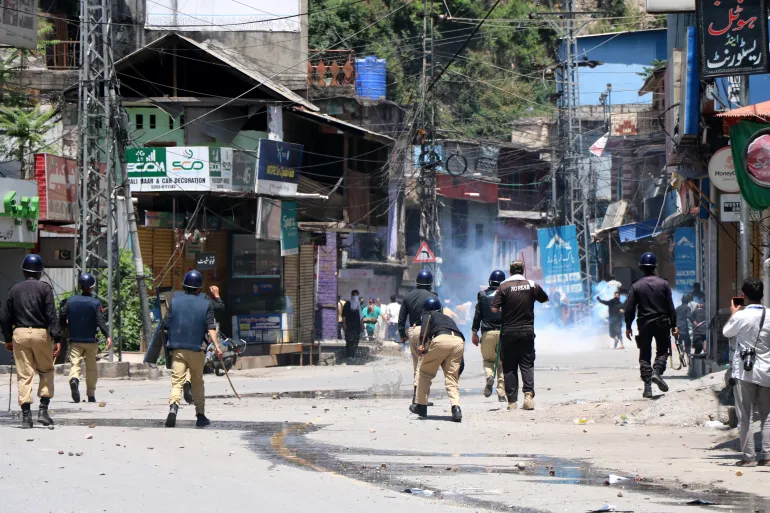
The partial victory of Mass Movement in Pakistan-administered Jammu Kashmir redirects the historical context. Whenever the popular masses came out in the form of organized social movements, they always force the upper class to bow down.
Mass Movement started on 10 May
The popular masses supported the leadership with full courage, From the beginning of the movement, the ruling class tried to use the various tactics to divide masses, the movement was still in its early stages when the state deepened the process of polarization by increasing the division between the leadership of the traders, but the small traders opened up against pro-state narrative and their leadership, recognizing the value of wrong from wrong and right from right.
They disagreed and were remain part of public action committees. Subsequently ongoing process was repeatedly propagated by the missing rulers of Pakistan administered Jammu Kashmir under the guise of people’s rights; India wants to make the situation worse through its agents, as this was the 76-year-old narrative of the ruling class, which was quickly defeated. On this stand of the ruling class, the popular masses kept saying in one voice that you give us rights; we will not have gone to the meeting of any Indian agent according to you.
Later the leadership of the Joint Mass Action Committee sat in the negotiations called by the government at different times, but the condition of the negotiated committee was remained very poor and with lame excuses, sometimes the members remained absent from the negotiations and sometimes it was said that they have no powers to approve public demands except authorities nominated by Pakistan, Seeing these actions and deceit of the government, the Joint mass Action Committee, in consultation with the sub-mass committees, chose February 5 as a day for the general strike, on which every year the state of Pakistan , on an official scale, hands with people of Jammu Kashmir for solidarity against India, When the importance of this strike was embedded in the consciousness of the popular masses, the government remembered the negotiations and once again invited the Joint Mass Action Committee for negotiations on February 4 to approve the demands and issued a notification accepted some of the demands partially.
Government asked for more time for left over, but when this notification started circulating among the masses through social media, the majority had not only criticized the partial acceptance of these demands but also called for a full strike on February 7. Keen-sighted on this public sentiment and criticism, the leadership, vowing to continue the movements until the demands are met, announced a sit-in in front of the Legislative Assembly of Jammu Kashmir on May 11, which was first reported by the state-run media. It was looking like news, but as the time approached and the momentum of the masses was built. Finally, on the night of May, 9 the state raided the houses of many leaders of the Joint Mass Action Committee and sub-committees from Mirpur Division and arrests was carried out, in response to which JAAC announced a general strike on May, 10 and called protests and rallies. The police created tension and mess across the state.
In the clash where many protestors and police personnel were injured, Sub-Inspector Adnan Qureshi succumbed to his injuries in the town of Islamgarh after being shot in the chest, where he along with other police personnel stopped the rally going to Muzaffarabad via Kotli. When all the caravans entered the Poonch division, at Rawalakot the district government on behalf of high ups once again invited the (JAAC) leadership for dialogues in a cheeky manner and made the masses wait for hours. As the ruling class was visualizing the masses have come in their traditional procession for trip and entertainment where on they receive free transport, good meal In order to make their meetings successful and during the public meeting, disgusted by elite’s ideas and speeches which compelled them to back homes, but this is bad luck rulers to understand that the masses who have been deprived for decades do not come out every time to have fun or show, but their consciousness also develops with the maturity of the state’s historical tricks and experiences, they learn from their objective conditions.
It means when the conscious subject in alignment takes the form of tomorrow, being the majority, it goes on to eliminate all the anti-human tactics of the minority. During the march, negotiations started between the ruling class and the leadership of the People’s Rights Movement, the people from below had only one demand. As the caravan approached Muzaffarabad, the ground began to crumble under the feet of the ruling.
When the gathering of millions of people, the beating of drums, the youth’s Bhangra (dance) revolutionary songs, slogans and the enjoyment with one and other’s drinks and food was becoming a discussion of popularity among the people of Pakistan on a large scale through social media. All internet services were immediately suspended, which was difficult for the ruling class to bear. On May 12, as a test, the paramilitary forces sent from Pakistan opened fire on the public, killing 3 youths and injure many others. The people responded back. They were trying to reach the place of firing from mountains, buildings, squares and intersections so that everyone accelerates to testify while the entire scenario was
being watched by the ruling class directly through the media. The paramilitary forces also understood the mood of this scene, so they fled there and immediately the ruling class had to accept the public demands.
How to maintain movement gains?
The courage of the people’s rights movement not only gave more courage to the people of Jammu Kashmir but also created a sense of collectivity within the people of Pakistan that if popular masses fight together for their rights, the rulers do not have enough power to grab them. The thrill can usurp our social media friends and colleagues who are congratulating the mass of Kashmir for their success and vowing that soon they will start a movement for their rights within Pakistan. Therefore, it is necessary to maintain continuous pressure on the ruling class from the village and town level to maintain the gains of the movement.
The expansions that have been achieved during the movement should not only be shared with each other but with women as well. There should be equally representation from village and town then take up problems of locality along with district level complete agricultural marketplaces and complete general hospitals should be demanded. It is possible when mass committees are consciously become part of the whole process with casting votes for every campaign under democratic centralism. Create possible efforts to make decisions by consensus; otherwise the decision of the majority should be given importance to the minority.
Kept the style of collectivity
This whole process should be done through People’s Assemblies which should be started from villages and towns and everywhere an effort should be made to possess the workers of services and production in these mass committees. The workers from different sectors ought to take the responsibilities for workers’ committees’ campaigns. Propagation should be done on the importance of an alternative Constituent Assembly by campaigning against the prevailing Pakistan-administered Legislative Assembly of Jammu Kashmir which stops anyone to participate in elections with the approach right of self-determination by partial constitution of 1974 , within each People’s Assembly.
This is the way to respond to the tricks of the ruling class while maintaining the success of the movement!
Humility is our conscious weapon
Pakistan-administered Jammu Kashmir is a colony of Pakistan, so it is important to include the element of humility and resistance in the movement for reforms, freedom and autonomy. Due to the success of the current people’s rights movement, many middle-class intellectuals and narrow nationalists are seen mocking the workers of Pakistan directly or through social media, saying that they should fight like Kashmiris, etc., due to the partial success of Jammu movement.
We need to understand that the situation in Pakistan is not exactly in the reactionary period but consciously the pre-revolutionary situation has
started.
The people have understood that the Pakistan ruling is completely incapable of providing any kind of public relief. Pakistan’s influence in the global market is zero. Unemployment has become a permanent problem.
The people at the bottom are preparing that the end of the prevailing ruling state which was first seen in the general election against the establishment, but it can be seen in the squares and intersections in the coming periods. Currently the slogans against the power of the establishment have become popular.
Repression against the oppressed nationalities can be advanced with end of inflation and privatization. If popular resistance starts on a large scale, it will not stop so quickly. Which has started first from Balochistan, then Gilgit-Baltistan and now Kashmir?
At this time, it is necessary that the leadership of the Jammu Kashmir People’s Rights Movement comes in defense of its achievements, appeals to the peoples of oppressed nationalities and working against oppression and fundamental rights infringed in Pakistan.