
 By developer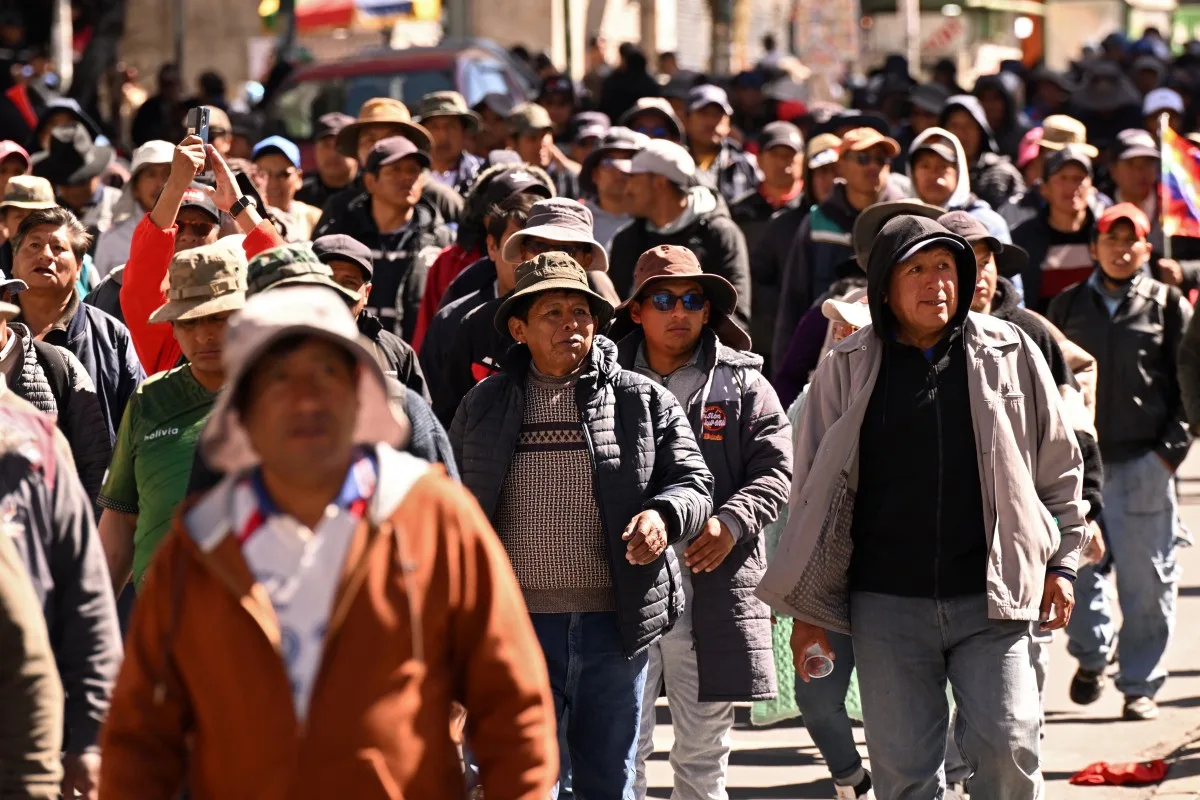
Lithium, Interimperialist Dispute, and Class Struggle in the Heart of Latin America
Eduardo Almeida (IWL) and Florence Oppen (Workers Voice, US).
Introduction
Bolivia is experiencing a new wave of blockades, strikes, and protests. This is not just another political crisis. It is a popular rebellion taking place in a world very different from that of 2003 and 2005. The international order has changed. But the exploitation of Bolivian workers remains intact. [1]
However, the inter-imperialist rivalry between the United States and China is not an abstract backdrop. It manifests in Bolivian political forces, shapes class alliances, and runs through the MAS crisis and the rise of Paz. The dispute over lithium, contracts with Beijing, and Washington’s backing of the new government: all of this is part of the same narrative. Therefore, to understand the popular rebellion of 2026, one must look simultaneously at the Salar de Uyuni and at the struggle between the world’s major monopolies. [2]
Within this framework, the Donald Trump administration pushed for a profound redefinition of U.S. strategy toward Latin America. U.S. foreign policy has increasingly defined China as its primary strategic competitor. The National Security Strategy published in December 2025 identifies competition with China as a central challenge of the period and places the Western Hemisphere among the United States’ strategic priorities. [3]
This strategy began to take shape in new economic and military initiatives. The United States promoted various mechanisms for international coordination aimed at securing access to critical minerals and reducing dependence on Chinese suppliers. [4]
At the same time, the United States promoted the Shield of the Americas, formalized in a joint State Department statement on May 21, 2026. Member countries—including Bolivia—expressed their support for the government of Rodrigo Paz amid social protests, which they characterized as an attempt to “subvert the constitutional order” supported by “criminals and drug traffickers. [5]
Therefore, the current Bolivian crisis should not be understood solely as an internal conflict. Resistance to economic adjustment, the social crisis, and the management of national resources are unfolding amid a growing inter-imperialist dispute over resources key to the global economy of the 21st century. Understanding the relationship between class struggle and the international order is essential to interpreting the historical significance of the current Bolivian rebellion.
Bolivia’s Economic Transformation (2003–2024): Boom, Crisis, and Renewed Dependency
To understand the current crisis, it is necessary to examine the transformations the Bolivian economy has undergone over the past two decades. The so-called “community-based productive socioeconomic model,” promoted by the MAS since 2006, rested on three pillars: the state’s recovery of a significant share of hydrocarbon revenues, increased public spending, and a strong expansion of state investment. Boosted by the international commodities boom, Bolivia experienced one of the longest periods of growth in its recent history. Between 2003 and 2024, nominal GDP rose from approximately $10 billion to nearly $47 billion, while GDP per capita increased from just over $1,000 in 2005 to around $3,800 in 2024. Extreme poverty fell from 38% to 15% during the same period. [6]
However, this growth, as in the rest of Latin America, has occurred as part of an adaptation to the international division of labor imposed by imperialism: essentially extractivist. The Bolivian case, which relied on tin for decades, now focuses on the production and export of natural gas (particularly to Brazil and Argentina), without developing the production chain. Rather than overcoming dependence, the commodities boom allowed it to be managed under exceptionally favorable conditions. [7]
From the second half of the 2010s, clear signs emerged that the gas cycle was exhausting, due to the end of the commodities boom and the decline in exports to Brazil and Argentina (which began producing more themselves). International reserves, which reached nearly $15 billion in 2014, fell to less than $2 billion in 2025. The Wall Street Journal described this decline as “one of the region’s most severe liquidity crises.” [8]
In this context, lithium became the Bolivian government’s primary strategic focus. “White gold” was expected to replace gas as the engine of growth. However, the results fell far short of expectations. Despite having the largest theoretical lithium reserves, Bolivia produced only 1,200 tons of lithium carbonate annually in 2024, compared with 200,000 tons in Chile and 150,000 tons in Argentina. After seventeen years of promises, the bumpy road to lithium industrialization has left Bolivia on the sidelines of the electromobility boom. [9]
At the same time, the structure of the country’s international economic relations underwent a transformation. In 2003, the United States was among Bolivia’s main trading partners. Two decades later, China had become Bolivia’s main trading partner and supplier, while the United States receded into the background. Chinese companies such as CAMC Engineering, Sinohydro, Huawei, TBEA Group, and the CBC consortium (CATL-Brunp-CMOC) became central players in the Bolivian economy. [10]
Bolivia’s dependence did not disappear but took on a more complex form. The profitability crisis in U.S. capitalism created an opportunity for the expansion of Chinese companies and financing. As documented in a thesis from the University of Barcelona (2024), Bolivia’s dependence has shifted, but it has not been broken: it has moved from dependence on U.S. capital to dependence on Chinese capital. [11]
The Lithium Triangle and the Inter-Imperialist Dispute
Latin America has become a central battleground in the dispute between the United States and China. More than twenty countries in the region, including Bolivia, Argentina, Chile, Peru, Ecuador, and Colombia, have joined the Belt and Road Initiative (BRI), and cumulative Chinese investment has exceeded $180 billion. [12]
In recent years, a significant shift has taken place. While Chinese investments initially focused on extracting raw materials, they now seek to control broader segments of the value chain. As noted by the Latin American Observatory on Mining Conflicts (OCMAL), China has shifted from flooding the lithium market to undermine the profitability of rival projects to securing long-term contracts with producers in Chile, Argentina, and Australia. [13]
Bolivia occupies a central position in this dispute. Together with Argentina and Chile, it forms the so-called Lithium Triangle, which holds about 60% of the world’s lithium resources. According to the U.S. Geological Survey (USGS), Bolivia has about 23 million tons of identified resources, Argentina 22 million, and Chile 11 million. However, the gap between geological potential and production capacity is enormous. In 2024, Bolivia produced only 1,200 tons of lithium carbonate, compared with 200,000 in Chile and 150,000 in Argentina. [14]
Lithium is not valuable as a raw mineral. It is valuable for what it enables: batteries, electric cars, and technological dominance at a pivotal moment in the transformation of the energy production matrix and the integration of AI across all levels of industry. Whoever controls the technology for extraction, refining, and cathode production reaps the lion’s share of the profits. Bolivia has the resource, but the revenue is generated in segments monopolized by a handful of transnational corporations.
China is today an “emerging imperialist power in conflict with the United States,” following the same logic as the classical powers: securing raw materials, markets, and investment to sustain its accumulation.^18 Its major corporations—CATL, BYD, CMOC, Zijin Mining, Ganfeng Lithium—operate as global monopolies: they export capital, control strategic technologies, and organize production chains on a global scale.
According to the International Energy Agency’s 2025 report, China controls 70% of global refining capacity for critical minerals and holds market shares of 80% or more across multiple segments of the battery supply chain, achieving a near-monopoly (over 95%) in materials such as lithium iron phosphate (LFP) cathodes. At the same time, the governments of Bolivia, Argentina, and Chile signed the Treaty on Lithium Cooperation and Integration in July 2025, seeking to increase their bargaining power against large corporations. [15]
While the United States and China vie for control of “white gold,” it is Bolivian workers—miners, peasants, factory workers, and transporters—who, with their bodies and struggles, uphold the possibility of a different path forward. The revenue from lithium does not reach their pockets. Yet their ability to bring the economy to a standstill and any government to its knees is the country’s true strategic power.
This presence is most clearly evident in the Lithium Triangle. In Chile, the U.S.-based Albemarle remains a leading producer, while China’s Tianqi Lithium acquired a stake in SQM. In Argentina, Ganfeng Lithium is involved in projects such as Cauchari-Olaroz. In Bolivia, the CBC consortium became YLB’s primary foreign partner. BYD, the electric car manufacturer that surpassed Tesla in global sales, submitted a proposal in May 2026 to build a battery plant in Bolivia. [16]
The dispute over lithium not only reshaped relations between Bolivia and the major powers but also reconfigured the Bolivian political system and accelerated the crisis within the MAS itself.
The MAS and Chinese Penetration in Bolivia
The Bolivian case illustrates the contradictions of so-called “21st-century socialism” in Latin America. After nearly two decades of MAS governments, Bolivia neither overcame its structural dependence nor developed its own technological base to industrialize its main resources. On the contrary, the depletion of the gas cycle and the bet on lithium deepened new forms of economic and technological subordination. [17]
The growing relationship between the MAS and China revealed a new configuration of class interests within the Bolivian bourgeoisie. While traditional business sectors maintained historical ties with the United States, MAS governments promoted the rise of new bureaucratic and technocratic sectors whose accumulation depended on state spending and coordination with new international partners. China offered financing and technology without demanding the reforms the IMF had historically imposed. This convergence facilitated the rapprochement between the MAS and Chinese capital.
During Evo Morales’s administration (2006–2019), the foundations of extractivist rent-seeking were laid. Lithium was declared a strategic resource not subject to concessions in the 2009 Constitution, and the state-owned company YLB was created in 2016. However, Morales’s strategy, based on “evaporation ponds,” proved ineffective at the Salar de Uyuni because of the high magnesium concentration. After a contract with the German company ACI Systems failed (canceled in 2019), Morales turned to China and signed agreements with TBEA Group and CAMC Engineering. [19]
The government of Luis Arce (2020–2025) made a radical shift toward direct lithium extraction (DLE), a technology Bolivia lacks. In September 2024, a $970 million contract was signed with the Russian Uranium One Group. In November 2024 and January 2025, contracts totaling $1.03 billion were signed with the Chinese consortium CBC. The Minister of Energy justified the move: “Russia and China have the technology that we do not have.” However, a judge suspended the projects in August 2025 after complaints from indigenous communities about a lack of prior consultation. The Center for International Private Enterprise (CIPE), linked to the National Endowment for Democracy, described the contracts as a possible attempt at “authoritarian capture” of the lithium industry. Indigenous and civil society organizations questioned the agreements for their lack of transparency. [20]
Arce’s administration deepened the shift: foreign capital took control of the technology, the MAS’s anti-imperialist rhetoric was set aside, and the elimination of fuel subsidies—implemented through Supreme Decree No. 5503 of December 17, 2025—enacted the austerity measures that Sánchez de Lozada had attempted in 2003. [21]
The Split in the MAS
The internal conflict between “Evismo” and “Arcismo,” which intensified between 2024 and 2025, goes beyond a personal dispute. Its origin lies in the struggle for control of the state, natural resource revenues, and major lithium projects. The split in the MAS reflected the contradictions arising from Bolivia’s involvement in the dispute between the United States and China. [22]
Arcism: The Chinese-Russian Bet. Arce bet on a strategic partnership with foreign capital capable of providing financing and technology, even if this entailed a strong dependency. This reflected the interests of officials and technocrats whose wealth accumulation depended on the continuity of these projects.
Evismo: opposition to the new power bloc. Morales became the leading critic of the agreements with China and Russia, denouncing their opacity and unfavorable terms. But these criticisms also reflected a political dispute: the success of Arce’s projects would consolidate a new power bloc within the MAS, thereby reducing Morales’s own influence.
Andrónico Rodríguez. The Senate president distanced himself from both parties and ran in the 2025 elections with his own party. This fragmentation proved fatal: the MAS, which had won 55% of the vote in 2020, garnered only 3.16% in 2025, coming close to losing its legal status. [23]
The historical limits of the MAS. For nearly two decades, it built a power bloc based on hydrocarbon revenues but failed to consolidate an autonomous base of accumulation. New bourgeois sectors began to form within the state apparatus, which split over control of lithium. When revenues declined, this weakness became an open political crisis. The lack of revolutionary leadership remains the weak point of the class struggle in Bolivia. [24]
The vacuum left by the MAS was the ground on which the traditional bourgeoisie began to reorganize. The fragmentation of the ruling party created an opening for business and political sectors that had been sidelined for nearly two decades to rebuild a common alternative. That alternative found expression in Rodrigo Paz. [25]
The Traditional Bourgeoisie and the Rise of Rodrigo Paz
Rodrigo Paz Pereira, son of former President Jaime Paz Zamora and a graduate of American University in Washington, D.C., won the 2025 election as part of the Alianza Patria coalition, which brings together Creemos (Camacho), Unidad Nacional (Doria Medina), SOL.bo (Revilla), and the MIR-Nueva Mayoría. It is a political front of the bourgeoisie, spanning the hard-line autonomist right to corporate neoliberalism. [26]
Paz’s program, Agenda 50/50, calls for radical decentralization, the elimination of tariff barriers, and the criminalization of social protest. Although he has declared his opposition to the IMF, his project is a classic structural adjustment: the elimination of subsidies, deregulation, and total openness to foreign capital. [27]
Paz’s government is the expression of a faction of the Bolivian bourgeoisie committed to reintegrating into the traditional circuit of accumulation: the United States, the IMF, and Western investors. They believe that by tying themselves once again to U.S. capital, they will secure greater income and stability. For workers, the difference is negligible: with one master or another, it is always they who pay the price for austerity. [28]
The Current Crisis: Popular Uprising, Repression, and Foreign Intervention
The popular mobilizations that began in December 2025 and intensified in May and June 2026 expressed a profound rejection of deteriorating living conditions, rising fuel costs, austerity policies, and the perception that strategic resources remain subordinate to external interests. Peasant organizations, indigenous groups, unions, and neighborhood councils once again took center stage. The Alto region regained the prominence it had held in 2003 and 2005. [29]
The government’s response has been repressive. The most significant feature, however, is the United States’ rapid intervention. On June 4 and 5, 2026, Secretary of State Marco Rubio and Secretary of Defense Pete Hegseth announced the dispatch of “emergency assistance” to the Paz government under the Shield of the Americas. Rubio described the protests as “an attempted coup financed by drug trafficking,” while Hegseth denounced the alleged return to “narco-terrorist rule.” For the first time since 2006, the United States intervened so explicitly in a Bolivian political crisis. [30]
While the United States openly backed Paz, China pursued a different strategy: avoiding direct intervention and focusing on ensuring the continuity of contracts. Through its embassy, it declared its “respect for Bolivia’s sovereignty” and its “confidence that the government will honor the contracts.” China does not need tanks to secure its access to Bolivian lithium: it has debts, contracts, and a network of intertwined economic interests. [31]
The strength of the workers’, peasant, and indigenous organizations contrasts with the absence of an independent, class-based political leadership. The COB, FEJUVE, and the peasant unions retain authority and the capacity to mobilize, but none has managed to articulate a common strategy to challenge for power. The fragmentation of the leadership of the masses—among Arcistas, Evistas, autonomists, and independents—is as real as that of the bourgeoisie.
The reformist politics of the “camps” once again reveals its true essence
Today, Bolivia is at the center of the continent’s class struggle. Trump secured a political victory in Venezuela by seizing control of the oil and installing Delcy Rodríguez. He is seeking another victory in Bolivia. If, on the other hand, the Paz government falls under pressure from the mass movement, it will be a serious defeat for Trump.
The sharp social and political polarization on the continent could lead to a revolutionary upsurge similar to those in Colombia, Ecuador, and Chile between 2018 and 2020, which the reformist leaderships channeled toward bourgeois democracy. But that upsurge is clashing not only with the far right and Trump but also with bourgeois democracy. Lula’s support for the Paz government against the masses symbolizes that policy: reformism allies itself with the bourgeoisie and imperialism to maintain peace and bourgeois democracy.
Neither the United States nor China: for an independent working-class solution
The Bolivian crisis reflects the convergence of three processes: the crisis of the international order following the capitalist restoration in the former USSR; the rise of China as a power capable of challenging the United States; and the crisis of the national-popular projects that sought to manage dependency without breaking with it. [32]
The growing aggressiveness of U.S. policy toward Bolivia—the NSS, the Shield of the Americas, and direct support for Paz—evidences the United States’ loss of influence over the past two decades. Regaining a presence in the Lithium Triangle is fundamental to its global strategy of competing with China. The competition for control of strategic minerals, supply chains, and investment opportunities is a concrete manifestation of the struggle for global accumulation. Within this framework, U.S. monopolies seek to regain ground amid the expansion of Chinese capital in Latin America, while the U.S. government serves as the primary political, diplomatic, and military instrument of those interests.
For nearly twenty years, the MAS did not alter Bolivia’s subordinate integration into the global economy. As CEDLA documents, the energy and fiscal crisis “is not temporary, but the result of an unsustainable model of production and consumption” based on extractive rents. The alliance with China and Russia prolonged the project’s viability, but when rents declined, the contradictions erupted. The traditional bourgeoisie took advantage of this collapse to regroup around Paz, backed by the United States.^33
The Bolivian masses have repeatedly shown they can topple governments (2003, 2005) and challenge established powers (2019, 2026). What they have lacked is not strength but political leadership capable of channeling that strength into a program of workers’ and peasants’ power. The COB, FEJUVE, and indigenous organizations possess moral authority and organizational capacity. What is lacking is the political will to break with reformism and the illusion that capitalism can be managed with a “human face.”
The Bolivian experience shows that the strength of mass mobilizations, on its own, does not resolve the question of power. The building of a revolutionary party rooted in the working class, peasants, and indigenous peoples remains a strategic necessity.^34
Let us make no mistake. The inter-imperialist rivalry between Washington and Beijing alters the forms of that domination but does not eliminate its class content. The only path to national sovereignty and true independence is for the Bolivian working class, allied with indigenous communities, to take power, place the economy and land under workers’ control, genuinely nationalize production, and break dependence on both imperialist powers and their interests in the country. That is why, today more than ever, internationalist solidarity with the struggle of the Bolivian people is essential.
The 2026 mobilizations have once again brought to the forefront a key issue in Bolivia’s contemporary history. The roadblocks, the COB, the FEJUVE, and the peasant organizations demonstrate that social forces can challenge the state. In this context, the slogan “All power to the COB” sums up the need for the working class and popular sectors to act on their own program. The main task of the new rebellion remains to transform this demonstrated strength into an alternative to power that challenges the government and paves the way toward a socialist Bolivia, integrated into a socialist federation of Latin America.
Notes
[1] On the crisis of the world order: Historical Materialism, vol. 32, no. 3, 2024; Perry Anderson, New Left Review 147, 2024; Graham Allison, Destined for War (2017); IISS, The Military Balance 2026
[2] Ibid.
[3] National Security Strategy 2025–2030 (The White House, December 2025); USGS, Mineral Commodity Summaries 2025.
[4] One example was FORGE (Forum on Resource Geostrategic Engagement), launched in February 2026 with 56 countries. Yonhap News Agency, February 5, 2026.
[5] U.S. Department of State, “Joint Statement by the Members of the Shield of the Americas,” May 21, 2026; Reuters, May 21, 2026.
[6] INE, National Accounts 2000–2024; BCB, Annual Reports; World Bank, Bolivia: Poverty Assessment 2025.
[7] ECLAC, Latin America and the Caribbean: Natural Resources, Development, and the Crisis of Extractivism (2025), chap. 4.
[8] The Wall Street Journal, “Bolivia’s Liquidity Crisis,” January 17, 2026.
[9] El País América Futura, “The Rocky Road of Lithium in Bolivia,” June 3, 2025; USGS, Mineral Commodity Summaries 2025.
[10] See note 11.
[11] University of Barcelona, doctoral thesis “Essays on the Political Economy of Trade Policy” (2024), chap. 4.
[12] ECLAC, “The Belt and Road Initiative in Latin America” (2024); LAC-China Network, Chinese Investment in Latin America 2005–2024 (2025).
[13] Observatory of Mining Conflicts in Latin America (OCMAL), “The Lithium Market,” April 24, 2026.
[14] USGS, Mineral Commodity Summaries 2025; Complutense University of Madrid, “Lithium Production and Marketing in the Lithium Triangle” (2025).
[15] IEA, Energy Technology Perspectives 2025; Mining.com, “Bolivia, Argentina, Chile sign lithium cooperation agreement,” July 25, 2025.
[16] Reuters, “BYD pitches lithium plan to Bolivia,” June 1, 2026.
[17] Maristella Svampa, Extractivism, Neo-Extractivism, and the Civilizational Crisis (2023); Pablo Stefanoni, Has Rebellion Turned Right-Wing? (2025).
[18] International Workers’ League (IWL), “China, the Emerging Imperialist Power in Conflict with the U.S.,” November 21, 2025.
[19] Financial Times, “The Curse of White Gold,” June 14, 2018.
[20] Contracts: Reuters, June 29, 2023, September 26, 2024, November 26, 2024. Suspension: Mongabay Latam, August 25, 2025. CIPE: Center for International Private Enterprise, “Securing the Lithium Sector,” December 2025.
[21] Supreme Decree No. 5503, December 17, 2025; El Deber, December 30, 2025.
[22] Página/12, “Bolivia: Self-Destruction,” October 19, 2025; The Guardian, August 24, 2025.
[23] The Guardian, August 24, 2025; SWI swissinfo/EFE, August 18, 2025.
[24] CEDLA, “Rentier Model, Crisis, and Multidimensional Poverty,” April 2025.
[25] Jonas Wolff (PRIF), “Back to the Future? Bolivia after the 2025 elections,” Más Poder Local No. 62, 2025; NACLA, “Bolivia and its Destiny,” October 28, 2025.
[26] NACLA, October 28, 2025; Supreme Electoral Tribunal, Resolution TSE No. 045/2025.
[27] Rodrigo Paz, Government Agenda “Bolivia 50/50” (December 2025); interviews with Reuters and FT, November–December 2025.
[28] Mining.com/Bloomberg, February 5, 2026; Reuters, February 5, 2026.
[29] Página Siete, May 20, 2026; El Deber, May 25, 2026.
[30] Marco Rubio and Pete Hegseth, statements June 4–5, 2026; APDHB, report June 5, 2026.
[31] Chinese Embassy in Bolivia, public statements, June 2026.
[32] See notes 1 and 2; CEDLA, “The Energy Crisis in Bolivia Is Structural,” October 31, 2025.
[33] CEDLA, Carlos Arze Vargas, “The obsession with supply,” October 31, 2025; KAS, “Bewährungsprobe für Boliviens Regierung,” May 29, 2026.
[34] On the need for a revolutionary party, see the Trotskyist tradition (transitional program, Fourth International).