
 By fabiobosco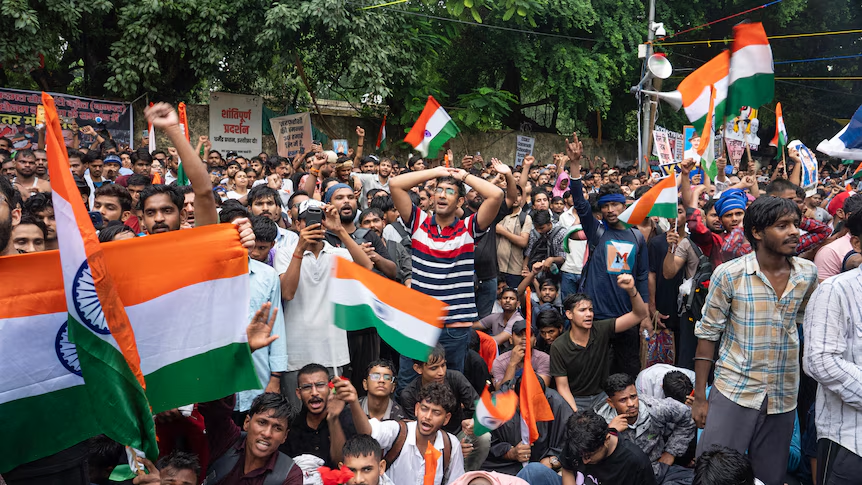
The government hoped that this act of brazen violence would intimidate the protesters, that fear of crackdown would break their resolve and force the students back home, ending the protests for good. That did not happen. On the contrary, the crackdown only intensified existing anger of the youth against the government, it galvanized sentiments in solidarity with Sonam Wangchuk and the youth protesters. The protests did not diminish, on the contrary it grew, exploding from what seemed to be a local protest into a nationwide protest.
The BJP was riding high on the confidence of securing its hold over the parliament, following the victory in West Bengal and the mass defections of the TMC parliamentarians towards the BJP. The youth protests have shattered this confidence. The BJP today finds itself surrounded in the capital by a full blown youth rebellion. Delhi is the main site of protests with protesters attempting to breach police barricades and storm the parliament. Large solidarity protests have taken place in Mumbai, Kolkata, Patna, Prayagraj (formerly Allahabad) and Surat.
Almost every state in India has witnessed student and youth protests, most led by leftist student unions but participated by youth from all walks of life. Up to fifty thousand students joined the protests at the Jantar Mantar protest site in Delhi, thousands gathered in Mumbai, protesters marched in the hundreds in Kolkata and Patna. Everywhere there were protests, the police acted against the students with particularly violent crackdowns in Delhi and Mumbai.
Till now, over a hundred students have been injured in Delhi, dozens arrested across the country. It goes without saying, that we offer our unconditional support to the movement.
Timeline of the protests:
At the heart of the protests was the mishandling of the NEET test. The National Entrance and Eligibility Test in India is a mandatory national entrance examination for admission to Undergraduate medical courses. It is conducted by the National test Agency, and counts as one of the largest examinations in the world, it remains India’s largest examination, accounting for over twenty million candidates appearing for the test.
The NEET exam first took place on the 3rd of May, but was cancelled after a series of paper leaks. The cancellation was followed by a spate of suicides of students who had studied hard all year for the exams, only to have their efforts turn to waste because of a few corrupt people rigging the system to their advantage. At the heart of the scandal is the education minister, Dharmendra Pradhan who has received the ire of the protesters.
Demands for Dharmendra Pradhan’s resignation rang out soon after the leaks were exposed. Suicides of aspiring students further fuelled public anger against the government and the National Test Agency. The government’s response was not accountability, but damage control. The NEET re-test was re-scheduled for the 21st of June and conducted under the protection of the armed forces. This marks not only a complete failure of the civilian administration to conduct a vital test, but the first time the armed forces had to be used to clear the government’s mess.
Anger against the government swelled, protests happened across the country but in a scattered and unorganized manner. In the midst of this, the Chief Justice of the Supreme Court made a statement calling the youth of the country ‘cockroaches’. This proved to be the trigger for a wider anger, leading to the creation of the movement under the banner of ‘Cockroach Janata Party’ (Cockroach people’s party).
Protests in Delhi began on the 6th of June under the banner of the CJP, with the core demand of resignation of the Education minister, Dharmendra Pradhan. Initially the protests found a lukewarm response with a few hundred joining in. The protests began to grow after being joined by noted social activist Sonam Wangchuk on the 28th. In the meantime, the government’s apparent success at the NEET re-examination had dulled enthusiasm for the protests. It seemed for a time that the protests would indeed die down.
By the middle of July, support seemed to be waning, despite the fact that Sonam Wangchuk’s hunger strike had evoked much sympathy throughout the country. His health kept worsening while the fight seemed to lose steam, all the while the government shunned any calls for accountability over the NEET paper leak. The combination of factors emboldened the government to strike. On the 18th of July, the Delhi police forcibly removed Sonam Wangchuk from the protest site and moved him to a hospital, the police also removed barricades and assaulted the protesting youth.
The government’s move backfired massively! Rather than diminishing the protests, it enraged the youth across the country. The sight of a respected activist being bundled out by force, and young protesters being assaulted by the Delhi police galvanized anger. Protests by the youth broke out in cities across the country. The CJP called for a march to the parliament on the 20th of July. This was expected to draw a crowd of three thousand by the police’s estimate, but up to fifty thousand people showed up.
The march to parliament under the leadership of the CJP was planned as a peaceful protest march to present demands to the government. This peaceful march was met with police batons, water cannons and tear gas attacks. The protesters resisted, but could not match the violence of the police, up to 150 protesters were injured with 70 protesters detained. The police did not spare anyone, even resorting to assaulting women, the children and the elderly. Eye witness accounts stated that the Additional Deputy Commissioner Sandeep Lamba personally assaulted a woman protester without provocation.
The march to the parliament failed to break through police barricades, but the determination of the youth did not die down despite police violence. The youth returned to the Jantar Mantar protest site, reclaiming it after the police had dismantled the stage and tents. The protests returned with vigour drawing larger crowds. The protests spread to major cities in the country, Kolkata saw 600 protesters march from Jadavpur University, in solidarity with the protesters in Delhi, Mumbai saw thousands of protesters. As of writing this article, another larger protest is planned in Kolkata.
The government’s response to the peaceful protest march was more repression. An internet blackout was imposed over the protest site in Delhi, metro stations were shut down. Sixteen of Delhi’s metro stations remain shut down as of writing this article.
Seeing the strength of the protests, opposition party leaderships joined the youth protesters. The police weren’t any more sparing towards them. Visuals emerged of Rahul Gandhi, the leader of opposition, being carried away by the police. The leaders of opposition parties were arrested and driven out in police vans.
As of the 24th of July, the CJP leadership has held meetings with the health minister J.P Nadda, presenting their gamut of demands. So far, the government has given no concrete path forwards, there has been no assurance on the resignation of Dharmendra Pradhan. While there has been an ‘in principle’ commitment to refrain from any further criminal prosecution on protesting students and youth, there is no action to this effect on the ground. Outside of Delhi, there have been large protests in Mumbai and Kolkata, with the demonstration in Kolkata primarily led by the CPIM linked Students Federation of India (SFI). The protests in Kolkata turned violent after the police attempted to violently stop the protesters from entering the vital Dorina crossing, in the city centre.
As the protests continue, solidarity marches and actions are being witnessed across South Asia, with marches taking place in Dhaka, Bangladesh. Anonymous supporters in Nepal have been sending food and assistance to the protesters in Delhi, while diaspora communities of Indians have protested in solidarity in Europe and the USA.
The nature of the protests and leadership:
As we had analysed in our June article ‘On the Cockroach Janata Party’, the protests are an expression of youth anger. The youth of the country aren’t only composed of students, but also include workers in exploitative industries like gig work, the unemployed, and casual workers. Despite this, workers unions are barely present in the protest. Students are in the leadership of the protests, with petty bourgeois leadership under the banner of the CJP in the lead.
It would be wrong to consider this a leaderless protest, or an unorganized protest. At the same time, it must be understood that the CJP is not an organized political party. Its existence began as an internet phenomenon which suddenly and quite suspiciously, became a platform for mass mobilization. Sonam Wangchuk was not a member of the CJP, though he became the defacto leader of the protest through his hunger strike.
The core demand of the resignation of the Education Minister Dharmendra Pradhan, but beyond this the CJP’s agenda does not reveal any desire for systematic change. The gamut of demands presented by the CJP to the health minister included;
Immediate release of Sonam Wangchuk.
The resignation of the education minister, Dharmendra Pradhan.
Rs. 1 crore compensation for the families all NEET students and aspirants who died by suicide following the exam paper leaks.
No legal action against protesters and the withdrawal of any FIR or legal proceedings against peaceful protesters at Jantar Mantar.
These are valid demands for the immediate scope of the protests, but they do not go towards any kind of systemic change. Merely changing the education minister will not bring about a change in the education system, and particularly not any change in the way entrance tests are conducted. The problems of the paper leaks can’t be seen in isolation as a mere error of management, it is the symptom of a deeper rot in India’s education system. For decades, the privatization of education has created conditions for profit driven education in place of education as a public right. With this, a nexus emerges where public education is systematically degraded to favour private education establishments with links to the ruling party.
At the same time, the lack of educational establishments creates a wide gap between the number of aspirants on the one hand, and the availability of seats. The gap is exploited by corrupt individuals in the administration of education, who sell seats like assets. Medical education is kept contained within a tight circle of wealthy and educated Indians. Seats get taken up, only by those who can afford the costs of education, or are able to bribe their way in. For poorer families, the system is rigged, regardless of how meritorious one might be.
These questions are not raised directly by the CJP, what started as a response to a callous insult by the Chief Justice of the Supreme Court has morphed into another petty bourgeois liberal movement, with very limited aims. The character of the CJP and every other bourgeois and petty bourgeois party was revealed over the course of the protests.
As of writing this article, Sonam Wangchuk has ended his indefinite fast, only on the assurance that opposition parties would take up the issue of the NEET paper leak before parliament. This move cleverly passes the buck on to the opposition, reducing the burden of accountability on the government. In an important concession from the government, the government has declared assurance that no FIRs would be filed against peaceful protesters, meeting at least one of the demands raised by the CJP.
While students were being beaten on the streets by the police, the leaders of the CJP were either in hiding, or negotiating with J.P Nadda. The spokesperson of the CJP was found eating at a fast food restaurant, an action for which he was removed. The protesters called on the education minister to resign, the slogans attacked the police and government, but Sonam Wangchuk satisfied himself with mere assurances, that too from the opposition. The actions show a clear gulf between the militancy of the youth protesters and the actions of the leadership.
As much as one might criticize the CJP, it must be acknowledged that the CJP at least made the earnest effort to bring the youth out to the streets. This does not match up to the rank hypocrisy of the INDIA alliance parties, chiefly the Congress party. While dramatic visuals of Rahul Gandhi being lifted out of the protest site have been widely circulated, less known is the Congress government’s actions in Kerala, a state it now rules. There, protesting students were lathi charged by the police in the same manner as the students and youth in Delhi.
The same bourgeois opposition that is placing itself on the side of the youth in Delhi are attacking the youth in states where it rules. Among the leftist parties, the CPIM and CPIML have participated through their students unions, they have played a major role in the initiation of the protests and ensuring that the movement would gain momentum, but it did so conceding leadership to Abhijit Dipke and the CJP.
Nowhere did any independent demands appear from the side of the SFI or AISA, the two largest students unions linked with the CPIM and CPIML respectively. By this, it must be understood that there is no desire or effort by either students unions to use this mobilization to push for systematic change. It is all the more confusing as to where they stand on the NEET exam system itself.
The BJP government’s drive to centralize all services was at the heart of instituting the NTA (National test Agency) and centralizing one national NEET in place of several state level entrance tests. The infrastructure for the same was simply absent, and today issues of transparency and security have come to the fore. Without an opposition to NEET and the NTA, simply standing beside the CJP in their protests rings hollow.
Though the SFI has been among the most ardent and active supporters of the students’ struggle, the CPIM has not brought the rest of its political machinery to bear in solidarity. We have seen protests fail because of the lack of a united effort, without an active solidarity across different sections, protests can become isolated and eventually curbed.
Our stand on the CJP and the protests:
In June we had expressed our support for the protests, while remaining critical of the CJP. The recent events have not changed our position. The CJP does not have an agenda for systematic change, let alone a revolutionary programme. We hold that the problems of education in India are rooted in Indian capitalism, and this can’t simply be reformed away, it requires a revolutionary struggle to change it. That in turn requires a revolutionary programme and organization.
At present however, the need is to build solidarity around the youth protesters throughout the country. The Indian government and every institution within it from the courts to the parliament to the administrative services and police, have shown that they are steadfast in their support of the capitalist order in India. The police in particular has shown that they will be brazen in their attack on any force that challenges the BJP government, the courts have shown that they will never side with democratic dissent, the government itself has shown that they have no regards to the lives of people.
In such conditions, solidarity is essential not just for the success of the movement but also to secure life and limb. India’s reactionary government must be exposed to the world, the world’s youth must stand by the Indian youth, the young workers and students, who are on the march today.
A mobilization like this has not been seen since the anti-corruption protests in 2011, and that in turn was part of a wave of protests in India. What makes this protest more significant is the timing, as it comes right after the youth rebellion in Nepal and Bangladesh which successfully toppled governments. The strength of the movement has been such that it has inspired the youth of Nepal, Bangladesh and Pakistan to march in solidarity as well. The immediate internationalism of the protests is contrasted with the perspectives of the leadership, which barely gets beyond the most immediate demands.
LONG LIVE THE YOUTH PROTESTS!
FULL SUPPORT TO THE YOUTH PROTESTERS!
DOWN WITH THE POLICE !
DOWN WITH THE BJP GOVERNMENT!
DHARMENDRA PRADHAN RESIGN NOW !
ABOLISH NEET ! ABOLISH THE NTA!