
 By adm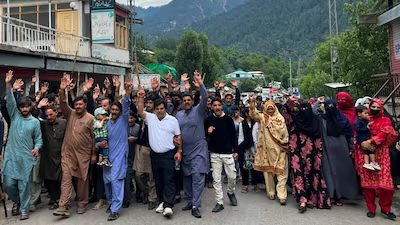
On September 29, 2025, complete blackout and strict security measures were imposed in Pakistan-administered Jammu Kashmir. However, the people refused to accept silence. What began in 2023 as protests against inflation, flour, and electricity prices has transformed by September 2025 into a broad-based people’s movement with a 38-point agenda. The Joint People’s Action Committee presented demands that were straightforward and organized, opposing powers, privileges, and political exclusion. The government responded with pressure, cuts, and violence by forces. Mobile and internet services were shut down; news was cut off; roads were blocked. Paramilitary forces were sent from Pakistan, resulting in at least nine martyrs and dozens of injuries in clashes. Yet, this oppression could not suppress the movement — it exposed the system’s weakness and the state’s disregard for fundamental rights.
State Tactics to Break the Mass Movement
As the movement started, instead of directly confronting the people, the state deployed a right-wing party (Muslim Conference). The main reason was that direct confrontation with millions could be dangerous for the state. Therefore, backed by state power and using loyal or proxy groups, clashes were incited, and innocent unarmed civilians were shot. Despite the bloodshed, the state sought to hide its crimes. Right-wing thugs were used to attack the people, and when protesters responded, they were branded as extremists or enemies of the state, justifying the heavy force used. This environment was carefully observed to gauge the extent of public support and tolerance for repression, essentially measuring the level of resistance. To divide unity, the state tried to portray peaceful protests as extremism to weaken the people’s solidarity. Kashmiri workers need to understand that such far-right groups survive on establishment support. Their use helps the state portray itself as a guardian of law and order while depicting the people as agitators and disruptors.
Lenin and Trotsky famously said, “The state uses reactionary and old forces as shields to crush the revolutionary energy or resistance of oppressed people.” When the people firmly opposed these tactics, the hired goons and forces were forced to retreat—soldiers and officers even abandoned their weapons and fled. The strength of youth resistance made the state tremble, prompting the Joint Mass Action Committee to be invited for negotiations.
What the People Achieved
On October 4, Pakistan’s government signed an agreement with the Joint Mass Action Committee (JAAC), aiming to end the tense situation that had arisen in Pakistan-administered Jammu Kashmir over the past days. After discussions, both parties agreed on an accord to swiftly end the ongoing movement.
Key Provisions of the Agreement:
• FIRs (First Information Reports) will be filed for casualties and clashes.
• FIRs related to incidents on October 1 and 2, 2025, involving deaths or injuries of law enforcement agencies (LEAs) and protesters, will be registered under the Anti-Terrorism Act, with a judicial commission appointed where necessary. Victims of the October 1 and 2 incidents will receive compensation equivalent to that given to LEA personnel. Injured persons will receive 1 million rupees in compensation, and a family member of each martyr will be provided government employment within 20 days.
• FIRs related to incidents in Banjosa (September 21), Muzaffarabad (September 30 and October 1), Ployk (October 1), Dhirkot (October 1), Mirpur (October 2), and Rawalkotli (October 1) will be forwarded to a judicial commission headed by a high court judge.
• Those arrested during October 2-3 in Islamabad and Rawalpindi will be released.
Reforms in Education and Cabinet:
• Two additional education boards will be established for Muzaffarabad and Poonch divisions, and all three boards of Pakistan-administered Jammu Kashmir will be linked to the Federal Board of Intermediate and Secondary Education. • Admissions in educational institutions will be open merit-based.
• The Pakistan-administered Jammu Kashmir government will release funds for health cards within 15 days.
• MRI and CT scanning machines will be provided in each district with federal funding.
• The Pakistan-administered Jammu Kashmir cabinet will be limited to 20 ministers/consultants, and the number of administrative secretaries will not exceed 20.
• Civil Defense will be merged into the State Disaster Management Authority (SDMA).
• The Anti-Corruption Bureau and Anti-Corruption Establishment will be merged into one body, governed by the NAB Ordinance.
10 Billion Rupees for Power and Infrastructure:
• The federal government will provide 10 billion rupees for improving the power system in Azad Kashmir.
• Feasibility studies will be conducted for the construction of tunnels at Kori/Kamser (3.7 km) and Chiplani (0.6 km) on the Neelum Valley Road, prioritized under the Saudi Development Fund.
• Under the Mangla Dam Raising Project, land occupancy of the families in Mirpur will be regularized within 30 days.
• Hydro projects will be implemented as per the 2019 High Court decision.
• Feasibility studies for water supply schemes in ten districts will be conducted in the current fiscal year.
• The transport policy will be reviewed, especially regarding the use of 1300cc vehicles.
Review of Refugee Seats:
An high-level committee will be formed to review the issue of seats for those coming from outside the Pakistan-administered Jammu Kashmir constituencies (i.e., the 12 refugee seats). This committee will include representatives from the federal government, Pakistan-administered Jammu Kashmir government, and two legal experts from JAAC. “Until the committee submits its final report, all funds, privileges, and ministries related to these seats will be suspended.”
Amendments to the Local Government Law:
• The current local government law will be harmonized with the original 1990 law and the Supreme Court’s decisions within 90 days. Health, Water, and Development Projects:
• Funds will be allocated from ADP for operating theaters and nurseries in Tehsil headquarters hospitals.
• Funds will be provided for the construction of bridges at Gulpor and Rehman (Kotli).
• Water supply schemes and transmission lines in Daddapani (Dadyal) will be funded through ADP.
• Property rights will be granted to refugees in Mandar Colony (Dadyal).
• Property transfer tax will be brought to the level of Punjab or Khyber Pakhtunkhwa within three months.
• Advance tax will be reduced similar to Gilgit-Baltistan and former FATA regions.
• The project timeline for Mirpur International Airport will be set within the current fiscal year.
Monitoring and Implementation Committee
A Monitoring and Implementation Committee will be established to oversee the implementation of the agreement, comprising representatives from the federal government, the Pakistan-administered Jammu Kashmir government, and JAAC.
Key members of the committee include:
• Federal Ministers Tariq Fawad Chaudhry and Aamer Maqam
• Two representatives from the Pakistan-administered Jammu Kashmir government
• Three representatives from JAAC
The committee will set timelines for resolving disputes, forming procedures, and executing every decision.
“It will also review existing privileges and facilities provided to the judiciary, government officials, and ministers, bringing them to a reasonable level.”
Constitutional Crisis in Pakistan-Administered Jammu Kashmir
Historical Background
After the partition of 1947, Pakistan-administered Jammu Kashmir, commonly called Azad Jammu and Kashmir, was established. However, rather than being an independent or truly democratic state, this region has always remained under direct Pakistani influence. The provisional constitution of 1974, which functions as an act, forms the basic legal framework of this state, but it has continually suppressed the genuine autonomy and self-determination rights of the Kashmiri people.
Under this act, the Kashmir Council, dominated by Pakistani authorities and the Prime Minister of Pakistan, holds decisive authority over finances, administration, defense, foreign affairs, and communications. The so-called Azad Assembly is limited and cannot pass laws on these matters. Any political force or party that does not accept the idea of accession with Pakistan is barred from participating in elections.
Current Crisis
On September 29, on the call of JAAC, millions of people demonstrated unity around the 12 reserved seats in the Pakistan Legislative Assembly for Jammu and Kashmir refugees, along with 37 other fundamental rights issues. These 12 seats are allocated for refugees residing in Pakistan, and they have been a major political debate for years.
Public circles and various movements have repeatedly questioned the role and legitimacy of these seats. Since most representatives elected from these seats are candidates from major Pakistani political parties with little direct connection to local issues in Jammu and Kashmir, they are often used by these parties to increase their majority in the assembly. These seats frequently raise questions about the people’s right to self-determination and local autonomy. Representatives elected with just a few hundred votes spend large budgets on luxuries for themselves and their patrons, considering themselves entitled to 25% of the state’s administrative quota. This is altering the state’s subject role in Jammu Kashmir, and even before independence, the demographic balance has been disturbed.
Criticism of Leadership
While we stand in defense of the Jammu and Kashmir JAAC, we also occasionally criticize its central leadership. We believe that honest critique is the best approach, which tests every perspective and strategy and adopts positions according to capacity, based on principled understanding.
The JAAC was founded in 2023 by active workers from committees fighting for fundamental and democratic rights across districts and tehsils for years. They felt an urgent need for a central coalition to coordinate their struggles over common issues. Without a formal conference, workers from each district sent three to four representatives to form an organizing committee to synchronize local sub-committees with the central JAAC. It was agreed that representatives from every layer would be included to build a strong committee.
However, the leadership, mostly influenced by traders and second-tier nationalist parties with a centralist approach, has maintained a lack of certainty and seeks to keep the structure of JAAC intact without rank or file participation. Before this movement, for about a year and a half, conferences were held across Jammu and Kashmir under the banner of “Right to Governance and Ownership,” without resolutions, glorifying past successes but lacking a clear strategy for new struggles.
During these conferences, when progressive activists proposed ideas such as establishing people’s assemblies in villages and towns based on the Kashmiri question, constitutional crisis, and issues, with provisions for recalling leaders and equal pay for workers, the leadership spread propaganda that sub committees aimed to split the movement. Consequently, on September 29, 2025, a complete lockdown was announced without organized public mobilization.
Meanwhile, when the state began inciting attacks on the public in Muzaffarabad and other places through the right-wing Muslim Conference, the movement called for a peaceful long march toward Muzaffarabad. The state used its proxies and machinery in districts like Mirpur and Bagh, leading to the martyrdom of young protesters, who fought back, after which the attackers abandoned their weapons and fled or were arrested.
Realizing the gravity of the situation, the state quickly invited the JAAC leadership for negotiations. The leadership insisted on direct talks with the Pakistani government because the assembly representatives, due to protests, had lost their governing legitimacy, and negotiations took place on the demands mentioned earlier. It appears that the agreement reached will require the people to take to the streets again to ensure its implementation.
Post-Movement Developments
During the movement, during the signing of the agreement between JAAC and the Pakistani government, two members of the Jammu Kashmir Legislative Assembly and three members of JAAC participated symbolically.
Following this, all central, district, and tehsil-level political and administrative decisions should have involved JAAC members as stakeholders, but this did not happen—responsibility lies with the central leadership of the committee. The state is systematically tightening its grip around activists who played active roles in the movement. Many young people, arrested on the pretext of possessing weapons seized from forces, are mostly those who fought to protect others from violence and pushed back against the forces.
The state is detaining these youth to weaken the movement and to target the leadership of sub-committees trying to move the movement forward. Therefore, it is essential for JAAC to call defense conferences at the district and tehsil levels, giving each local committee the right to confront state repression with popular resistance, with other committees standing in support.
Revolutionary / Constituent Assembly Campaign
We have repeatedly emphasized that the struggles of the working class involve constitutional issues. For socialist perspectives, the struggle is only possible if we adopt a revolutionary stance on the democratic question—namely, to defend all democratic demands and fight for their revolutionary implementation, including the constitutional question.
The slogan of a Constituent Assembly has historically played a central role in revolutionary democratic struggles, even during bourgeois revolutions like the French Revolution of 1789, the European Revolutions of 1848, and the Russian Revolutions of 1905 and 1917. Marx, Engels, and Lenin’s writings bear witness to this. Many revolutions afterward also saw this role.
In essence, a Constituent Assembly is an institution elected solely to draft and decide on the constitution of the state. It is a place where representatives of conflicting classes present their programs on how society should be governed. Therefore, a Constituent Assembly is the most “radical” form of bourgeois democracy because it involves the working classes in debates on the political and economic structure of society.
Marxists do not believe that a socialist system can be peacefully established through such assemblies alone. The abolition of the capitalist government and the expropriation of its property are questions that will ultimately be settled through armed conflict between ruling and oppressed classes.
However, this does not mean Marxists should ignore such institutions. We support utilizing every possible institution to present a complete revolutionary program for social change. Such struggles can help show the masses that these institutions cannot solve society’s fundamental problems.
To make a Constituent Assembly more democratic and revolutionary, Marxists propose that representatives be elected based on local people’s assemblies, be recallable at any time by their voters, and receive only wages equivalent to skilled workers.
Recent global events and historical experiences demonstrate that revolutionary slogans, especially the call for a Constituent Assembly, can be presented in two ways: revolutionary and reformist. Reformist democratic demands appeal to bourgeois states and emphasize parliamentary routes, avoiding mobilizing the working class and masses. Usually, reformist and centrist calls for a Constituent Assembly are promoted by ruling classes who summon such assemblies, leading them to serve as tools of bourgeois rule.
In contrast, revolutionary calls demand a Constituent Assembly under the control of the revolutionary masses—organized in action committees and armed militias. Such an assembly would be a product of revolutionary uplift, where the working class holds power or at least a dual power situation exists.
When do Marxists raise the slogan of a revolutionary Constituent Assembly?
We believe that this is not an universal slogan applicable in every country or situation. Our position on this slogan is:
“In circumstances where fundamental issues of political sovereignty are on the agenda, and the masses are not yet conscious that workers’ democratic councils are superior to a Constituent Assembly, a revolutionary slogan for a Constituent Assembly can be relevant. Bolshevik-Communists support representatives being under the control of the people and constantly recallable. Such an assembly should not be a tool of the ruling class but should be convened through a revolutionary government of workers’ and common people’s committees.”
Therefore, we propose raising this slogan where struggles or capitalist political systems bring fundamental democratic questions to the forefront. This could be in countries with military juntas or semi-bourgeois governments like Bonapartism, or where the working class’s struggle exposes constitutional issues.
Until workers and popular classes understand the illusions of bourgeois democracy, Marxists should promote the slogan of a revolutionary Constituent Assembly in these circumstances.
The revolutionary/people’s rights movement’s courage has not only inspired Kashmiri people but also fostered a sense of unity among Pakistan’s people, fighting against oppression and democratic questions. They are determined that if the masses unite in their struggle for rights, rulers will not have enough power to usurp people’s rights. Our social media friends and acquaintances, disregarding anti-Pakistan propaganda, are repeatedly congratulating on victories and pledging to further organize the movement within Pakistan for their rights. To preserve the gains of the movement, it is crucial to continue applying pressure from villages and towns.
During the movement, experiences should be shared, and demands for women and men, rural and urban issues, along with district-level markets and complete general hospitals, should be raised through community committees.
This process is only possible when public committees are consciously involved in every stage. Under democratic centralism, every campaign should be decided by voting, and efforts should be made to reach consensus or, failing that, prioritize the majority decision—regardless of whether organizers belong to the minority—this is the best way to foster equality, humility, and unity among the people.
All this should be implemented through People’s Assemblies starting from villages and towns, with efforts to organize workers’ committees within their institutions. Every People’s Assembly should campaign strongly against the partial constitutional law of Pakistan-Administered Jammu and Kashmir, especially the restrictions on participating in elections, and propagate the importance of an alternative revolutionary Constituent Assembly.
This is the way to keep the movement’s momentum alive and respond to the rulers’ tactics of confusion and repression!
Therefore, the struggle should proceed without trusting these rulers, who are constantly moving forward. Now, these neo-colonial rulers daily tell the people that Pakistan commits injustices and fails to fulfill promises—when the predator gets caught in the trap, it begins to complain about the trap itself.
It is necessary to seize the opportunity of their inconsistency. The people should not rely on their authority but must involve all state stakeholders—including representatives of the common peoples, workers’ leadership, the middle class (lawyers, professors, doctors, traders, transporters), students, and women—in the campaign for a revolutionary Constituent Assembly that will undertake constitution-making and lead a revolutionary assembly for Kashmir’s independence.
This Kashmir movement is not merely regional unrest but part of a global struggle against repression, resource plunder of oppressed nations, neoliberal policies, the privileges of the political elite, and unemployment. When basic needs are withheld and privileges reserved for a few, resistance is inevitable. Repression through blackout and bullets makes it impossible to suppress this reaction, as seen in Pakistan-Administered Kashmir.
The constitutional crisis in Pakistan-Administered Kashmir is not just a legal issue but a question of power. The Karachi Agreement, the 1974 Act, and the structures around them are tools of dominance rejected by the people. The people are no longer willing to be passive spectators; a revolutionary solution will not be fulfilled through constitutional reforms or demands alone. Instead, the active struggle of Kashmiri workers will build a democratic and socialist Kashmir through the experience of a revolutionary Constituent Assembly.